THE DANGEROUS CONSTRICTION OF NIGERIA’S DEMOCRATIC SPACE

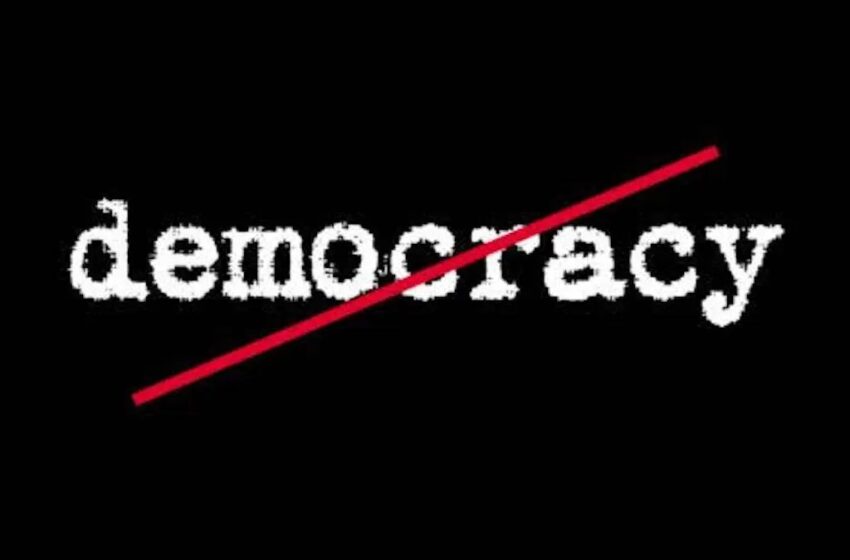
The 2027 elections are approaching, but the growing intolerance of political opposition by governments at different levels raises troubling questions about the future of our democracy.
There is something deeply troubling about the direction of Nigeria’s political development as we approach the 2027 general elections. Beyond the familiar arguments about political realignments, party defections, electoral calculations and the struggle for power, there is an emerging phenomenon that deserves far greater national attention – the gradual constriction of the political and democratic space by governments at both the national and sub-national levels. Quite frankly, it scares me.
Democracy, by its very nature, thrives on competition, disagreement, dissent and the freedom to organise. It presupposes that those who seek political power must be prepared to contend with alternative ideas, competing interests and opposing political forces. The right to govern does not confer the right to monopolise the political space, just as electoral victory does not translate into ownership of the state or its institutions. Unfortunately, recent developments suggest an increasingly disturbing disposition among some political actors to treat opposition as an inconvenience that must be contained, rather than an essential component of democratic governance.
A few weeks ago, the African Democratic Congress (ADC) raised allegations that the Sokoto State Government was deploying administrative pressure and other measures to frustrate its presidential campaign activities in the state. The party alleged interference with accommodation arrangements for its delegates, restrictions on access to facilities and other attempts to obstruct its rally. These allegations generated considerable controversy and eventually forced the party to reconsider aspects of its original arrangements. The government and its political allies have offered different explanations for some of the developments.
Now, a similar controversy has emerged in Kaduna State, where the ADC has accused the government of denying it access to Ranchers Bees Stadium for its scheduled political activities, despite the ruling APC having used the same facility for its campaign flag-off on October 24. The Kaduna State Government has disputed the authenticity of the letter reportedly communicating the refusal, describing it as forged. These competing accounts deserve proper scrutiny, but the underlying question about equal treatment of political parties and access to public facilities remains important.
The danger is not necessarily confined to these two incidents. It is the possibility that such conduct, if normalised or left unchallenged, could gradually become an accepted template for political engagement across the country. This is where the matter becomes considerably more serious than the immediate political disagreements between the parties involved.
The 1999 Constitution of the Federal Republic of Nigeria, as amended, is unequivocal about the fundamental rights of citizens. Section 39 guarantees freedom of expression, including the freedom to hold opinions and receive and impart ideas and information without interference. Section 40 guarantees the right to assemble freely and associate with other persons, including the right to form or belong to political parties. These are not privileges that governments may dispense at their convenience. They are constitutional guarantees that bind public authorities at every level of government.
Of course, the Constitution recognises certain permissible limitations on fundamental rights under Section 45. However, restrictions must have a legitimate legal basis and cannot become instruments for political discrimination or the selective suppression of opposition activities. A government cannot invoke public order as a convenient excuse to frustrate political competition while providing favourable access and accommodation to its own political organisation. If a public facility is available for one political party, the principles of fairness, transparency and equal treatment demand that other parties be subjected to the same objective criteria. Public infrastructure belongs to the public, not to the political party occupying the Government House.
More fundamentally, the shrinking of democratic space has implications beyond the fortunes of individual political parties or candidates. It affects the credibility of the electoral process, weakens public confidence in democratic institutions and gradually erodes the culture of political tolerance upon which constitutional democracy depends.
We must also appreciate the dangerous implications of creating a political environment in which opposition parties increasingly feel excluded from legitimate democratic participation. When peaceful political expression is frustrated, when access to public spaces becomes a partisan privilege and when dissent is treated as an act of hostility against government, the consequences can be far-reaching. This is particularly concerning in a country already grappling with deep economic frustrations, insecurity, social divisions and declining public confidence in political institutions.
The warning by former President Goodluck Jonathan about the possibility of post-2027 electoral crises should therefore not be dismissed as another routine intervention by a former political leader. His concerns about political intolerance, the mobilisation of young people for political violence, ethnic rivalry and the weakening of public confidence in democratic institutions deserve serious national consideration.
Democracy is not sustained by elections alone. It is sustained by the institutions, conventions and civic freedoms that make elections meaningful. A country can conduct elections and still gradually lose the democratic culture that should give those elections legitimacy.
There is also a fundamental contradiction in governments that seek to enjoy the legitimacy of democratic elections while appearing uncomfortable with the very freedoms that make electoral competition possible. You cannot demand the right to campaign for political power while denying others the same opportunity. You cannot celebrate political participation when it serves your interests and regard it as a security threat when it benefits your opponents. The responsibility for preserving democratic space rests particularly with those who wield governmental authority. They have the institutions, resources and coercive powers of the state at their disposal. It is therefore incumbent upon them to demonstrate restraint and ensure that public institutions remain neutral arbiters rather than instruments of partisan advantage.
The Independent National Electoral Commission, security agencies, the judiciary, civil society organisations and the media must also remain vigilant. The protection of democratic freedoms cannot be left entirely to the political actors who stand to benefit from restricting them.We must understand that democracy is a collective inheritance, not the proprietary asset of whoever happens to win an election.
What happens in Sokoto or Kaduna today could become the political culture of another state tomorrow. What is tolerated against one opposition party today could eventually be deployed against another party, or even against those who currently exercise governmental power.This is precisely why we must resist the temptation to rationalise or excuse violations of democratic freedoms simply because they affect political opponents with whom we disagree.
The real test of democratic leadership is not how comfortably a government accommodates its supporters, but how fairly it treats those who oppose it. Nigeria cannot afford to enter the 2027 general elections with an increasingly constricted political space, weakened institutions and an atmosphere in which political competition is perceived as a threat to public order. We have a responsibility to defend the constitutional freedoms that generations of Nigerians have struggled to secure. The right to disagree, organise, assemble and seek political power must remain inviolable within the limits of the law.
If we allow the gradual erosion of these freedoms to pass without challenge, we may wake up to discover that we have normalised a political culture whose consequences none of us can confidently predict. And that is what should worry every Nigerian, irrespective of political affiliation.
Democracy must not become a privilege granted by the government. It is a constitutional right guaranteed to the people.